THE RIGHT TOOL. A BETTER BUILD. Independent thinking for UK tool buyers
Our approach
UNDERSTAND THE TRADE-OFF

Track saw vs circular saw: compare the whole setup

A track saw is built around a compatible rail-guided approach to straight cutting. A conventional circular saw is a broader portable saw category and may work with particular guides or accessories. The useful comparison is not “accurate versus inaccurate”: it is which complete arrangement suits your cuts, workpiece sizes, storage and budget. Check the exact tool-and-guide system rather than assuming every rail fits every saw.

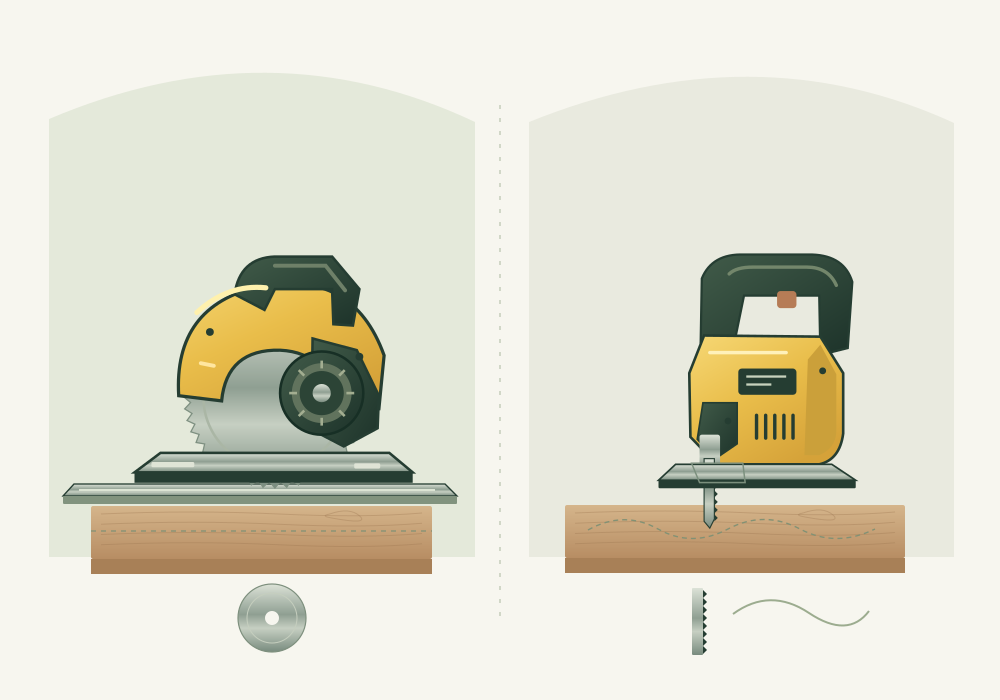
Illustration accompanying the comparison of track saw system and conventional circular sawTHE JOB COMES FIRST.

Educational tool-type comparison. General principles and buying considerations; no hands-on testing, model rankings or verified live prices. Check exact product documentation before buying.

THE SHORT VERSION

Two approaches.
Different strengths.

01 / YOUR OPTIONS

Track saw system

A saw and compatible rail arrangement designed to work together for guided straight cuts.

Where it helps

  • A coherent system to consider for repeat panel and sheet work.
  • Rails can provide a defined approach to positioning a straight cut.
  • Plunge capability may be part of a particular model’s documented design.

Keep in mind

  • Rails and compatible accessories add storage and purchase requirements.
  • A track does not establish suitability for every material or application.
  • Saw, rail, connectors and other accessories need exact compatibility checks.
02 / YOUR OPTIONS

Conventional circular saw

A portable circular saw considered with the guidance and accessories appropriate to its exact design.

Where it helps

  • Worth considering for varied straight-cut tasks.
  • A suitable setup may already fit tools and accessories you own.
  • The complete purchase can be simpler when a dedicated rail system is not needed.

Keep in mind

  • Guidance arrangements vary; do not assume universal rail compatibility.
  • A low tool-only price may omit useful support or guidance accessories.
  • Capabilities such as plunge cutting must not be assumed from appearance.
SIDE BY SIDE

The differences that matter.

These are type-level distinctions. Features, fittings and capacities vary by exact model.

Track saw system and Conventional circular saw: buying considerations
ConsiderationTrack saw systemConventional circular saw
Starting briefRepeated guided straight cuts, often involving panelsVaried portable straight-cut work
GuidanceA specified compatible rail systemAppropriate guidance varies by saw and accessory
Purchase to compareSaw, rail lengths and necessary system accessoriesSaw plus the guidance and support the job requires
Space to planRail handling, storage and full workpiece supportSaw storage plus the complete working arrangement
Important limitationA rail is not a substitute for checking the exact applicationA circular saw is not automatically a track or plunge saw
PUT THE JOB IN THE PICTURE

Which sounds like your work?

01 / THE SITUATION

Regular projects involving straight panel cuts

Investigate a compatible track saw system

Price and plan the rails, storage and workpiece support along with the machine.

02 / THE SITUATION

A range of occasional straight-cut jobs

Compare conventional circular saw setups

Consider whether suitable guidance and accessories cover the actual work without an extra system.

03 / THE SITUATION

You already own rails or a saw

Verify compatibility before expanding

Existing equipment is useful only if the proposed combination is documented and suitable.

Think in terms of a system

A rail-guided saw is not just a differently shaped machine. The rails, accessories, workpiece support and room to position them are part of the purchase. Think about the sizes of panels or boards you expect to handle and whether you have somewhere suitable to work on them. The machine footprint alone gives an incomplete picture.

Compatibility deserves a line in your buying brief. Check the saw, rail and accessory model information, including any stated limitations. Similar-looking profiles do not establish that parts from separate systems can safely work together. Product titles and informal advice are not substitutes for the manufacturer’s documentation.

Compare equivalent complete arrangements

A saw body at one price and a saw-plus-rail package at another are not equivalent offers. List the items you actually need for each approach: an appropriate blade, support, guidance, any required connectors and storage. If cordless, include the compatible batteries and charger. Count useful components, not simply the number of pieces in the box.

Also consider the work you do after the first project. If guided panel cutting will be a regular part of it, a coherent rail system may make more sense than collecting individual accessories later. If most cuts are shorter, less frequent or already covered by a suitable setup, the extra system may not solve a meaningful problem.

Keep claims about finish and accuracy specific

A guide can help define a straight cutting path, but the result still depends on the material, blade, setup and use within the instructions. Do not assume that a rail makes every cut suitable for visible joinery or that every conventional circular saw produces a poor edge. Relevant evidence should describe the exact equipment and conditions.

Plunge cutting is another model-specific distinction. Some track saws are designed for it; that does not turn the feature into a safe assumption about another saw. This comparison is about choosing the kind of equipment to investigate, not instructions for making a particular cut or a measured ranking of competing systems.

Keep these in mind.

  • Compare complete systems rather than machine-only prices.
  • Check exact rail, saw and accessory compatibility.
  • Keep finish, accuracy and plunge capability claims model-specific.
BUILD THE REST OF THE PICTURE

A useful next read.

Explore the knowledge base →