THE RIGHT TOOL. A BETTER BUILD. Independent thinking for UK tool buyers
Our approach
UNDERSTAND THE TRADE-OFF

Circular saw vs jigsaw: straight lines or shaped cuts?

Before choosing a saw, describe the cut. Are you reducing a sheet along a straight line, trimming a board, or following a shape? Circular saws and jigsaws can both be portable, but their blade motion and typical strengths are different. Start with the material, cut shape and support you can provide. Then check the exact saw and blade, rather than choosing whichever machine appears to do the most jobs.

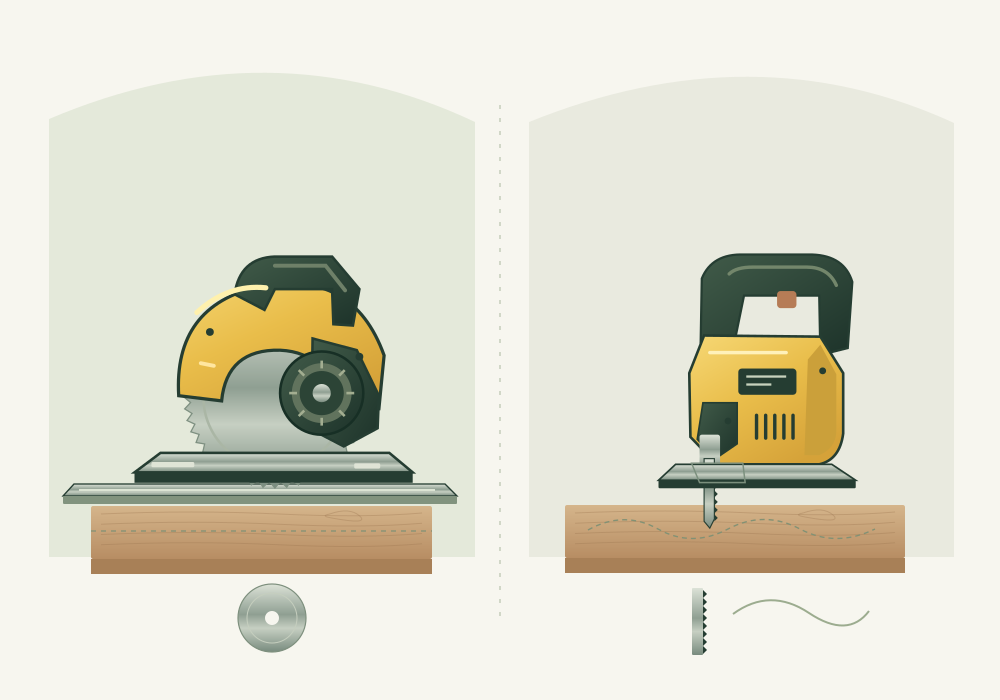
Illustration accompanying the comparison of circular saw and jigsawTHE JOB COMES FIRST.

Educational tool-type comparison. General principles and buying considerations; no hands-on testing, model rankings or verified live prices. Check exact product documentation before buying.

THE SHORT VERSION

Two approaches.
Different strengths.

01 / YOUR OPTIONS

Circular saw

A portable saw with a rotating circular blade, commonly considered for straight cuts in suitable material.

Where it helps

  • A natural starting point for repeated straight cuts in boards or sheet material.
  • Compatible guides may help with a planned straight-cut setup.
  • Blade choices can match different documented applications.

Keep in mind

  • It is not the choice for following a tight curved line.
  • Blade size, bore and application must match the exact saw.
  • The workpiece needs appropriate support and working clearance.
02 / YOUR OPTIONS

Jigsaw

A portable saw using a narrow reciprocating blade, often considered for curves and shaped cut-outs.

Where it helps

  • Useful when the cut needs to follow a shape rather than only a straight line.
  • A range of compatible blades can suit different documented materials.
  • Can be a practical addition for varied project shapes.

Keep in mind

  • The label does not guarantee a square, clean edge in every material.
  • Blade fitting and application must match the tool and job.
  • It is not automatically the most convenient choice for long straight sheet cuts.
SIDE BY SIDE

The differences that matter.

These are type-level distinctions. Features, fittings and capacities vary by exact model.

Circular saw and Jigsaw: buying considerations
ConsiderationCircular sawJigsaw
Cut shape to considerStraight cutsCurves, shapes and suitable cut-outs
Blade motionRotating circular bladeReciprocating narrow blade
Accessory checksDiameter, bore, application and guide compatibilityBlade fitting, application and suitable cutting capacity
Working setupSupport and clearance for the board or sheetSupport, access and clearance for the planned shape
Buying priorityThe straight cuts you repeatThe shapes and access your projects require
PUT THE JOB IN THE PICTURE

Which sounds like your work?

01 / THE SITUATION

Several long straight cuts in suitable sheet material

Investigate a circular saw setup

Check the full cutting arrangement, including support, blade and any compatible guide.

02 / THE SITUATION

A project with curved outlines or shaped openings

Investigate a jigsaw

Confirm blade compatibility, capacity and access for the actual shape and material.

03 / THE SITUATION

One simple occasional cut and little working space

Consider alternatives before buying

A suitable hand tool or cutting service may solve the need without storing another machine.

Describe the result, not just the material

“Cutting wood” covers very different jobs. A long cut through a sheet, a short board cut and a curved opening may lead to different equipment. Note the size of the workpiece, the line you need to follow and which edge will remain visible. These details are more useful than starting with a general claim that one saw is more powerful.

Neither type guarantees a finished edge on its own. Material, blade choice, support and the tool’s condition all play a part. If a particular surface finish or accuracy matters, look for relevant evidence for that exact combination rather than assuming every saw in a category will produce it.

Include the blade and workspace in the decision

Treat the blade as part of the setup. Check the fitting and dimensions specified for the machine, the intended material and any other requirements in the instructions. A blade that physically appears to fit is not enough evidence of suitability. Do not assume that one blade is appropriate for every material on a project.

Portable does not mean a saw can be used anywhere. Plan how the workpiece will be supported, how much room the whole cut requires and how dust or debris will be managed. A modest machine in a suitable workspace can be a more useful purchase than a larger tool you have nowhere appropriate to use.

Buy for the cuts you are likely to repeat

If your projects mostly involve straight cuts in boards and panels, a circular saw is worth investigating before a jigsaw. If shaped work is central to the project, the jigsaw’s narrow blade makes its role clearer. Some workshops use both because the jobs are complementary, not because either tool is universally better.

For occasional work, include a suitable hand saw or a professional cutting service in the options. The answer does not have to be another power tool. Compare the cost of a complete usable setup, including blades, compatible guidance if needed, storage and support, against how often the equipment will genuinely be used.

Keep these in mind.

  • Describe the cut before choosing a saw type.
  • Include compatible blades, support and dust management.
  • Do not treat tool type as a guarantee of finish or accuracy.
BUILD THE REST OF THE PICTURE

A useful next read.

Explore the knowledge base →